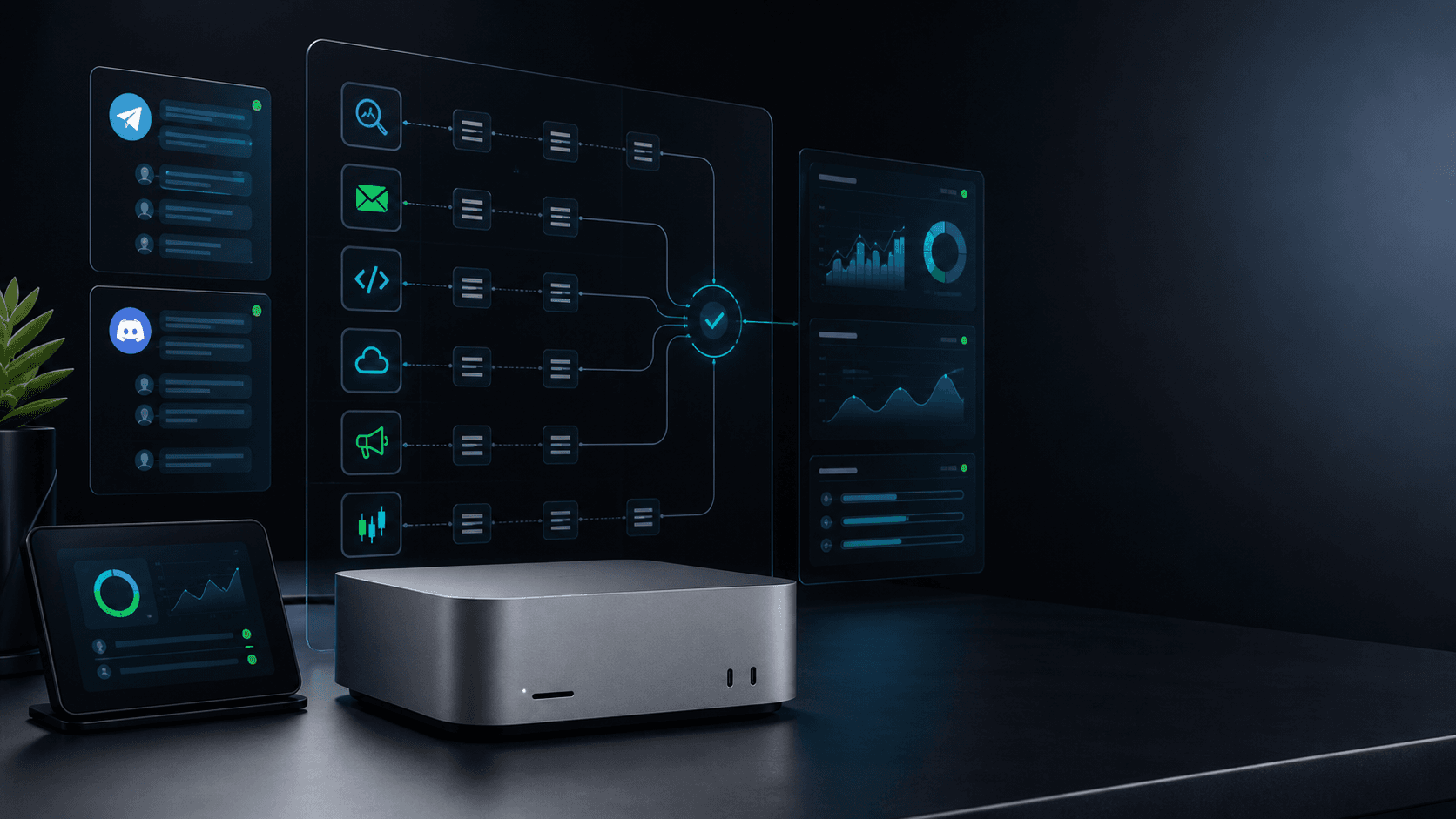
Dedicated Mac mini AI operator workstation
Back to the setup offer
Research and trading workflow operator

Put a research operator between you and the noise.

I set up a dedicated Mac mini AI operator that builds research briefs, watches approved sources, prepares event notes, checks your rules, journals decisions, and keeps every alert human reviewed.

20-second reserve

Claim a founder install

10
left
0 of 10 founder installs claimed0%

Want to send the details now? The full application is below. Priority is reviewed before invoicing.

6
Research loops
18
Operator tasks
10
Founder slots
$100
Monthly upkeep

The real bottleneck

Research is not scarce. Judgment bandwidth is.

Markets, customers, competitors, and macro news can throw more information at you than one person can sanely review. The work is not only reading. It is source checking, deduping, comparing prior notes, watching events, recording decisions, and knowing when a signal is just noise.

The operator I set up does not replace judgment. It creates the environment around judgment: approved sources, watchlists, research briefs, event prep, risk-rule checks, and journal receipts you can inspect before you act.

This is deliberately not an autonomous trading pitch. It is a decision-support system for people who want better research hygiene, faster triage, and a calmer operating loop.

What the first install does

  • A private research runbook for your approved sources, watchlists, alert rules, review cadence, and no-advice boundary.
  • A dedicated Mac mini with browser sessions, source feeds, local notes, scripts, and the research tools your workflow needs.
  • Telegram or Discord access so you can request briefs, daily alert triage, journal updates, and risk-rule checks in plain English.
  • A first research loop such as watchlist monitoring, earnings prep, decision journaling, or news alert triage.
  • Human-review guardrails that prevent the bot from presenting alerts, summaries, or rule checks as financial advice.
  • Monthly maintenance so sources, prompts, watchlists, journals, and escalation rules do not drift.

The playbook

Six research loops that keep speed and caution in the same room.

Each loop starts supervised. The operator gathers evidence, labels uncertainty, records source links, and tells you where owner judgment is still required.

01

Market research briefs

Interesting tickers, sectors, products, and macro themes show up all day, but the notes stay scattered across charts, newsletters, filings, and browser tabs.

A research-brief operator that gathers source links, summarizes the thesis, separates facts from assumptions, and packages the questions you should review before taking action.

  • Collect source material
    Pull together filings, company pages, news links, analyst notes you provide, transcripts, and your own prior notes into one research packet.
    The bot labels source age, missing access, and unsupported claims instead of presenting thin research as certainty.
  • Separate thesis from evidence
    Turn messy research into a brief with thesis, counterpoints, catalysts, assumptions, and open questions.
    The bot does not provide investment advice or tell you to buy, sell, or hold.
  • Build review questions
    Create a short checklist for what you should inspect manually before changing a watchlist or trade plan.
    Human review is required before any financial decision or public claim.
02

Watchlist monitoring

You care about a handful of names, sectors, customers, or competitors, but signal gets buried under alerts, social noise, and stale dashboards.

A watchlist operator that checks your approved sources, flags material changes, explains why the alert fired, and keeps a daily evidence log.

  • Track approved sources
    Monitor the tickers, sectors, RSS feeds, filings pages, product pages, or price levels you explicitly define.
    The bot only monitors approved sources and does not scrape private or restricted data without permission.
  • Explain alert triggers
    Write a short note for each alert showing the trigger, source link, timestamp, and reason it matters.
    Alerts are informational decision support, not instructions to trade.
  • Suppress repeated noise
    Deduplicate alerts, group related items, and mark which signals are new versus already reviewed.
    The bot records suppressed alerts so the owner can audit what was not escalated.
03

Earnings and event prep

Earnings calls, investor days, product launches, and macro events create research work before and after the event, usually at the worst possible time.

An event-prep operator that builds a pre-event checklist, watches for the release, summarizes the transcript, and compares management language against prior notes.

  • Prepare the event pack
    Collect the event date, prior quarter notes, expected topics, key metrics, and questions to listen for.
    The bot distinguishes your own expectations from public facts and source-backed numbers.
  • Summarize post-event changes
    After the event, summarize reported metrics, management commentary, changed guidance, and unanswered questions.
    The bot avoids predictions and flags when a source is preliminary, delayed, or incomplete.
  • Compare language over time
    Highlight repeated phrases, changed tone, new risks, and differences from prior transcripts or prepared remarks.
    Language comparisons are research notes and require owner interpretation before action.
04

Risk rule checks

The hardest part of discretionary trading is not finding ideas. It is following your own rules when the market is loud.

A risk-rule operator that checks your prewritten rules, position notes, sizing boundaries, calendar constraints, and review checklist before you act.

  • Read the written rules
    Load the trading rules, risk limits, blocked conditions, and review cadence you define in advance.
    The bot cannot invent new rules or override written owner constraints.
  • Run pre-action checks
    Compare a proposed action against your checklist and return pass, warn, or blocked with the reason.
    The bot does not execute trades; it only checks your stated rules for human review.
  • Record exception notes
    If you choose to override a rule, the bot captures the stated reason and adds it to the journal.
    Exceptions are logged as owner decisions, not bot recommendations.
05

Portfolio and decision journal

It is easy to remember outcomes and forget the actual reason you made a decision, which makes improvement almost impossible.

A journal operator that turns your notes, screenshots, alerts, and post-action reflections into a searchable decision log.

  • Capture the pre-decision state
    Record the date, source links, thesis, risks, intended review date, and what would disconfirm the idea.
    The bot asks for missing owner rationale instead of filling it in.
  • Summarize review outcomes
    On the review date, collect what changed, what was right, what was wrong, and what needs a follow-up note.
    Performance notes are descriptive and avoid promises about future returns.
  • Find repeat patterns
    Group journal entries by thesis type, source quality, rule exceptions, and post-decision lessons.
    Pattern summaries stay educational and require human judgment before process changes.
06

News alert triage

Breaking news can create panic, but most alerts are either duplicates, low-signal commentary, or missing the source you need.

A news-triage operator that sorts alerts by source quality, novelty, watchlist fit, and whether a human should read it now or later.

  • Score alert quality
    Classify alerts by primary source, secondary commentary, duplicate item, rumor, price-only movement, or operational update.
    Rumors and unverified claims are clearly labeled and never promoted as fact.
  • Build a read-now queue
    Put genuinely material items into a concise queue with source, timestamp, affected watchlist item, and why it was escalated.
    Escalation means read now, not trade now.
  • Create end-of-day digest
    Summarize what mattered, what was ignored, what needs follow-up, and which sources created the most noise.
    The digest is for research workflow improvement, not financial advice.

Experience matters

I am selling the operating loop around the model.

The useful part is not a magic signal. It is the system that checks sources, preserves context, separates assumptions from facts, escalates uncertainty, and writes down the decision trail.

I have 25+ years of software experience building the systems that turn messy data, workflows, and decisions into repeatable operations.

I built and ran a 7-figure consulting company where client-facing automation needed audit trails, review boundaries, and practical judgment.

I launched 40+ SaaS products and internal tools across research, reporting, marketing, coding, deployment, email, and business operations.

This offer already uses the same operator discipline: source checks, live verification, blocked-state reporting, and Obsidian receipts before claims.

Guardrails

Built to avoid the exact AI trading hype that gets people hurt.

No investment advice

The operator packages research, alerts, and rule checks. It does not tell you to buy, sell, hold, or guarantee returns.

Human review first

Every decision remains yours. The bot can surface evidence, contradictions, and checklist results before you act.

No autonomous trades

The launch setup is decision support and journaling, not a bot that places trades or bypasses your broker controls.

Sources stay visible

Alerts and briefs include source links, timestamps, uncertainty, and missing-access notes so you can audit the work.

Limited founder queue

I am taking 10 founder installs, not unlimited alert bots.

The install is $1,000, then $100/month for upkeep. The priority lane is for founders and operators who already know the first research loop matters and want to move ahead after fit review.

Your first research loop mapped before setup.
Your approved sources and alert boundaries documented.
Your Telegram or Discord operator interface configured.
Your queue position captured through the same signup system.

20-second reserve

Claim a founder install

10
left
0 of 10 founder installs claimed0%

Want to send the details now? The full application is below. Priority is reviewed before invoicing.

Questions

What careful operators ask before automating research.

Will this bot trade for me?

No. The default setup is research support: briefs, watchlists, alert triage, risk-rule checks, and journaling. It does not execute trades or give investment advice.

Can it monitor my watchlist?

Yes, if you define the tickers, sectors, events, sources, and alert rules. The bot returns source-backed notes and labels alerts as read-now research, not trade instructions.

Can it help with earnings calls and filings?

Yes. The operator can prepare pre-event checklists, collect source links, summarize post-event changes, and compare language against prior notes for human review.

What does it cost?

The founder install is $1,000 to set up and $100/month for maintenance. Priority-lane requests are reviewed for fit before any credited invoice is sent.

More operator installs

Research is one loop. The same setup can run the rest of the business.

Founder queue

Reserve one of 10 AI bot installs

10
left

$1,000 setup, then $100/month. Telegram or Discord operator.